Render farm in your office
ProRes RAW, Red R3D, BRAW, and ARRI MXF decode on hardware blocks — NVENC, the ProRes engine, the Apple Media Engine. The CPU stays free for noise reduction and neural effects.
Premiere, DaVinci Resolve, Final Cut — at full GPU, on the iPad on your lap. Hardware H.265 and 48 kHz audio in lockstep. The same timeline you left on the workstation.
Most video on the internet is encoded 4:2:0 — one colour sample per 2×2 block of pixels. Fine for entertainment, wrong the moment you reach for the colour wheel. Edges between red and green smear, skin tones drift toward yellow, and the vectorscope lies to you. From a Mac with Apple silicon or a Windows PC, Remio's H.265 stream carries HDR end to end to a device with an HDR screen — and true 4:4:4 chroma for razor-sharp grading references is live today from NVIDIA PCs to Mac.
True color for grading references — on its way to your suite.

Remote editing separates compute from interaction. The render rig stays in the studio on gigabit fibre; the client travels with you. Remio is the wire between the two.
ProRes RAW, Red R3D, BRAW, and ARRI MXF decode on hardware blocks — NVENC, the ProRes engine, the Apple Media Engine. The CPU stays free for noise reduction and neural effects.
Boris FX Sapphire, Red Giant, Neat Video, Magic Bullet, Frame.io — all installed on the host, all at host GPU speed. Your dongle stays plugged into the workstation; licence keys never move.
Scrubbing is the most latency-sensitive edit action. Remio's input path is separate from the video path — your scrub reaches the host in about 8 ms of processing, measured internally — the rest is your display's own 60 Hz refresh cadence. The playhead tracks under your finger or jog wheel with no perceptible delay on LAN.
Share the streaming session with a colourist on a second iPad. The reviewer sees pixels in the same colour space the colourist grades in — no transcode, no Vimeo round trip, no "it looked different in the conform".

An iPad with Apple Pencil is a startlingly good colour surface. Point, tap, and scroll with the Pencil — Remio passes it to the host as a precision cursor, mapped 1:1 with no smoothing or acceleration. Pull a curve point in Resolve's RGB curves and it follows the tip exactly. Paint a power-window mask and the spline lays down where you draw.
Scopes on the iPad, timeline on the workstation — both at 120 fps.
Out-of-sync audio is the single most common complaint about remote editing tools. Remio's audio path rides the same hardware clock as the video — they leave the host on the same frame and arrive together.
Most tools resample audio through software — 48 kHz becomes 44.1 kHz with a shifted frequency response. Remio passes 48 kHz straight through, so music mixed for picture and dialogue ADR play back true to the original mix.
Audio and video leave the encoder on the same timestamp and arrive at the renderer on the same timestamp — no perceptible lip-sync drift, even over a long session.
Play, pause, scrub, or hit a marker from the client — the host's audio responds on the same beat as the picture, because it's one stream, not two synced separately.
Audio and video ride inside the same end-to-end encrypted session — no separate conferencing app, no re-encoding through a call codec, no extra hop for the sound to take.
A composite of three editor workflows we've seen since Remio shipped. Names changed, projects abstracted, hardware specs preserved.
A senior colourist runs Resolve Studio on an M2 Ultra Mac Studio with a Sumo reference monitor and a Tangent Wave 2 panel. From the train she works on a 14" MacBook Pro — the grade is bit-identical because both sessions read the same project files on the same Mac Studio.
A doc editor runs Premiere on a 13900K + RTX 4090 tower with native R3D 8K footage. On the iPad Pro he splits program left, source right — Pencil scrubs the source, finger taps the cut points. Export runs on the tower while the iPad closes for lunch.
A wedding videographer runs FCP on an M2 Mac mini in the office closet. From the kitchen table he edits on a MacBook Air with an iPad propped alongside mirroring the video scopes panel — both displays updating at 120 fps with no lag.
Direct answers, no marketing detour.

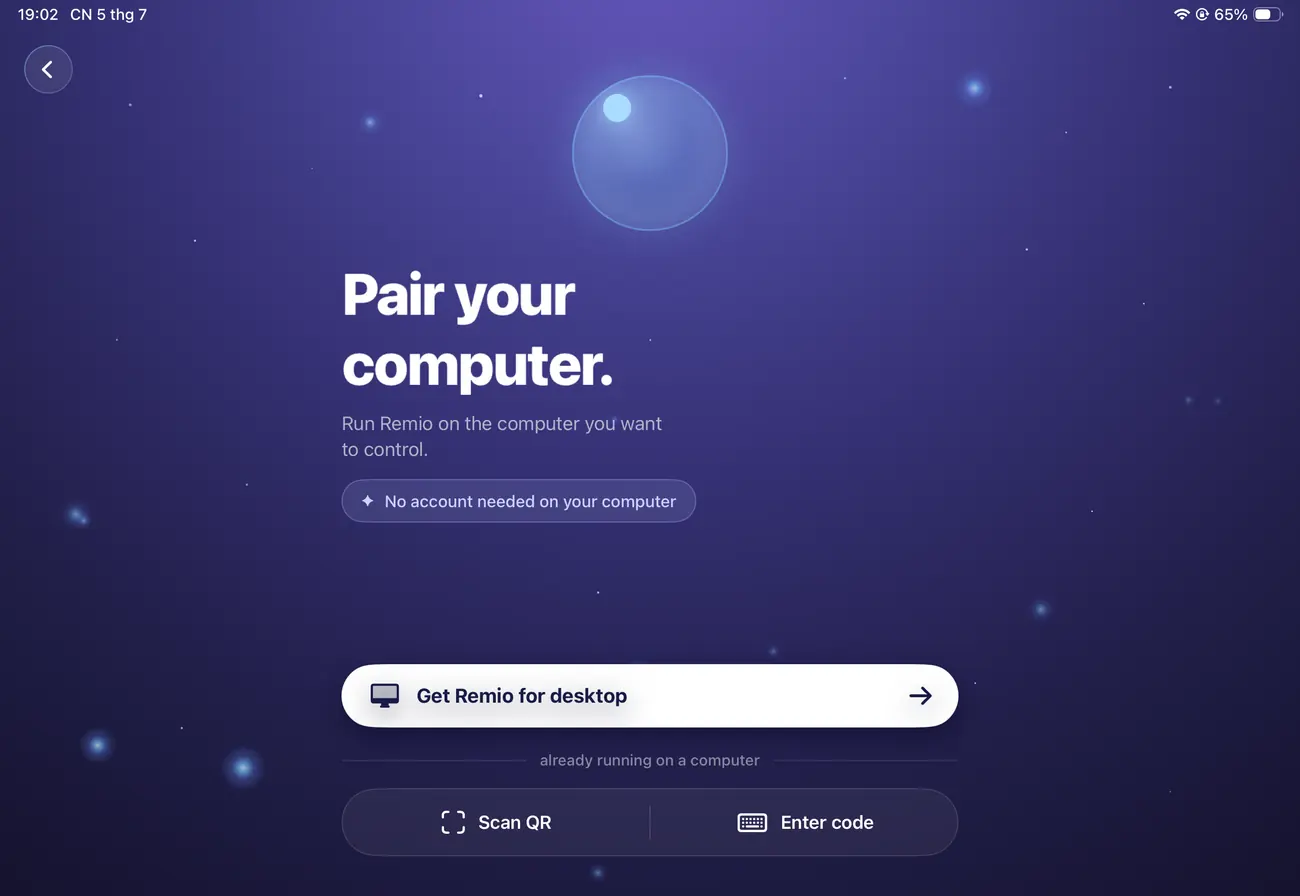
Install Remio Host on the workstation with the GPU and the dongle, the client on the iPad or MacBook you carry, and pair once with a six-digit code — free, no account, no card.
Free to useNo accountPaired in 30 seconds