Compare · Remio vs Apple Screen Sharing

Modern codec vs 2007 VNC, side by side.

Bottom line — choose Remio to stream a Mac to any device — iPad, iPhone, Windows, or Android; keep Apple Screen Sharing for a quick Mac-to-Mac session on the same LAN. An honest comparison across latency, image quality, cross-platform reach, security, setup, and pricing. Apple Screen Sharing is the built-in macOS tool that has shipped on top of VNC since macOS 10.5 in 2007 — free, convenient on a LAN, and Mac-only on both ends. Remio is a modern, native, codec-based remote desktop with about 8 ms of LAN processing latency, hardware H.265 encoding, and clients on every platform you own. Numbers are current as of May 2026.

Head to head

Remio vs Apple Screen Sharing at a glance

Thirty-five rows across performance, security, the account model, platforms, setup, and pricing. Where Apple Screen Sharing is genuinely ahead — zero-install Bonjour discovery inside one household — the table says so.

CapabilityRemioApple Screen Sharing
Performance
LAN processing latency~8 ms processing~50–150 ms
WAN typical latency (same region)30–80 msManual setup only
Maximum resolution4K (3840 × 2160)4K (stutters in practice)
Smooth frame rate ceiling60 fps~30 fps on a clean LAN
TransportDirect UDP + WebRTCTCP VNC (RFB)
Video codecH.265 · H.264 (hardware)VNC framebuffer (ZRLE / Tight)
Chroma subsampling4:4:4 on NVIDIA PC → Mac24-bit RGB framebuffer, no codec concept
HDR pass-throughNot yetNo
Audio passthroughYes, 48 kHz low-latencyNo
Monitor switchingSwitch between monitors (one at a time)Yes (display picker)
Security
Transport encryptionDTLS-SRTP, end-to-endOptional SSH tunnel (off by default)
Data-channel encryptionEnd-to-end encryptedCleartext VNC unless SSH-wrapped
Key exchangeEphemeral per-session keysVNC handshake (DES-derived)
End-to-end between devicesYes (no relay decrypts payload)Yes (direct connection)
Pairing modelSix-digit code per deviceApple ID or local user credentials
Account & access
Account requiredNoApple ID or local account on the Mac
Identity exposed to the connectionNone — pairing is per-deviceApple ID or system username
Central directory of hostsNoneBonjour (LAN) or iCloud contact list
Address book / hosts listLocal, on deviceFinder sidebar / Contacts
Platform support
macOS hostNative (macOS 15+)Native (macOS 10.5+)
Windows hostIn active developmentNo
macOS clientNative (SwiftUI)Native (Screen Sharing.app)
iOS / iPadOS clientNative, Apple Pencil support + hardware keyboardNone — third-party VNC only
Android clientNative (Jetpack Compose)None — third-party VNC only
Windows clientNative (C++/WinRT)None — third-party VNC only
visionOS clientNativeNo
Setup & discovery
Install on hostDownload Remio Host PKGBuilt into macOS — no download
Setup time~1 minute (install + PIN pair)~30 seconds inside one household
LAN discoveryPairing PIN (manual entry)Bonjour, visible in Finder sidebar
WAN / outside the LANAutomatic STUN + TURN relayPort-forward 5900 manually or use a VPN
Apple Pencil & touch inputPoint, tap, and scrollNot supported
Gamepad (button mapping)YesNo
Pricing (May 2026)
Personal use$0 (4K 60fps, dedicated virtual display)$0 (built into macOS)
Cross-platform clients$0 on iOS, iPadOS, Android, Windows, visionOSNot available; third-party VNC apps cost $5–$30
Admin / fleet managementPlannedApple Remote Desktop $79.99 one-time (separate app)
The verdict

Which one should you pick?

Remio wins on latency, image quality, cross-platform reach, encryption, and automatic WAN. Apple Screen Sharing wins on one thing that matters a lot inside a single household: zero-install convenience. Here is the honest split.

Choose Remio if…

You stream from a Mac to anything other than another Mac.

You want about 8 ms of LAN processing latency instead of 50–150 ms, modern H.265 video instead of a VNC framebuffer (with true 4:4:4 color now live from NVIDIA PCs to Mac (more pairs on the way)), and native clients on iPhone, iPad, Android, Windows, and Vision Pro — with Apple Pencil, audio, and gamepad passthrough. You want a six-digit code that works the same on LAN and across the country, with no port forwarding and no Apple ID in the loop.

Stick with Apple Screen Sharing if…

It is a quick Mac-to-Mac session in the same house.

Bonjour discovery and zero install make it the path of least resistance for an occasional admin task between two Macs on the same Wi-Fi, and it is the right choice when you do not own a non-Mac device and never expect to. For fleet management on Macs, Apple Remote Desktop ($79.99 one-time) still sits ahead of Remio's roadmap admin features today.

Detailed breakdown

Where each tool wins

Six categories, one paragraph each. The numbers in the table above are the headline; the paragraphs below are the why.

01
Latency

Direct UDP codec vs TCP framebuffer diffs

Apple Screen Sharing is built on VNC, which means every screen update is a framebuffer diff compressed with ZRLE or Tight, then shipped over TCP. That pipeline has no hardware video codec in it, so a fast move of a window or a quick scroll arrives in chunks that the receiver has to redraw — typically 50 to 150 ms after the input on a quiet LAN, and noticeably more when the network is loaded or the host is busy. The TCP transport itself is part of the problem: a single lost packet stalls the entire framebuffer until retransmission completes, which on a remote desktop pipeline reads as a brief freeze followed by a catch-up burst. Remio runs a direct UDP video stream with hardware H.265 encode on the host and hardware decode on the client, with no playout buffer and no retransmission of stale frames — lost packets trigger a fresh keyframe request instead of stalling the queue. Glass-to-glass on a LAN measures about 8 ms of processing (the rest is your display's own 60 Hz refresh cadence) — your input lands before the next frame draws. For an occasional admin task that gap means little; for actual interactive work it means the cursor and keyboard feel native instead of remote.

02
Colour and image quality

True video codec vs a 24-bit framebuffer

VNC was designed in the 1990s for desktop screen scraping, not for modern UI on Retina displays. Apple Screen Sharing still sends a 24-bit RGB framebuffer with ZRLE or Tight compression, which is fine when the screen is still and unpleasant the moment anything moves — text smears during scroll, gradients band, full-screen video drops to a slideshow, and 4K is technically supported but rarely usable above 1080p in practice. There is no chroma subsampling concept because there is no real video codec, and no dynamic-resolution adaptation worth the name, so a slow link does not gracefully degrade the way a codec stream does — it just stalls. Remio sends a true H.265 video stream today, and true 4:4:4 chroma — every pixel carrying its own colour value rather than sharing colour with its neighbours the way 4:2:0 broadcast video does — is now live from NVIDIA PCs to Mac (more pairs on the way). Text edges stay crisp, code editors and design tools render correctly, Final Cut and DaVinci timelines look right, and the encoder adapts gracefully under bandwidth pressure rather than freezing.

03
Cross-platform support

Native on every device vs Mac-only on both ends

This is where the gap is largest, and it is the single category that decides the outcome for most users. Apple Screen Sharing is macOS-only on both ends — there is no first-party Screen Sharing client app on iOS, iPadOS, Android, Windows, or Vision Pro. To reach a Mac from any of those devices you have to install a third-party VNC viewer, which inherits all of the latency and colour penalties of VNC plus a usually unpolished interface, no Apple Pencil support, no audio routing, and no touch gesture model worth the name. Remio ships a native client on every platform Apple ships and several it does not: SwiftUI on iOS, iPadOS, macOS, and visionOS; Jetpack Compose on Android; C++/WinRT on Windows. Apple Pencil input forwards to the host for point, tap, and scroll, Magic Keyboard and trackpad work as expected, gamepad input is passed through for cloud-gaming scenarios, and visionOS gets a true spatial window with eye-tracked cursor hover. If your workflow ever leaves a Mac — even occasionally — the built-in tool stops being an option.

04
Security

End-to-end by default vs cleartext VNC unless SSH-wrapped

Baseline VNC is unencrypted. Apple Screen Sharing has supported an opt-in SSH tunnel mode since macOS 10.5, which encrypts the connection, but it is not on by default and most users never enable it — meaning the password and the screen contents travel in cleartext on the local network for anyone with a packet capture tool. Authentication uses your Apple ID or the local user credentials on the Mac, which has two consequences: whoever connects sees those identifiers, and a lost or borrowed client device retains those credentials until you change them. The pairing model is also coarse — Screen Sharing trusts the account, not the device, so revoking access for one specific iPad or laptop means changing the password everywhere it is stored. Remio is end-to-end encrypted by default — your screen never touches our servers, and even a relay only sees ciphertext. Pairing is per-device with a six-digit code you can rotate anytime, so there is no Apple ID to leak, each authorised device is independently revocable from the host, and the media path uses fresh ephemeral keys for forward secrecy on every session. The connection server transits only ICE candidates during setup; once the peer-to-peer link is up, no Remio infrastructure can decrypt the payload even in principle.

05
Setup and discovery

One PIN everywhere vs zero-install inside one house

Apple Screen Sharing's killer feature is convenience inside one household, and there is no point pretending otherwise. Enable it once in System Settings under General → Sharing → Screen Sharing, and every Mac on the same Wi-Fi network shows up in the Finder sidebar under Network thanks to Bonjour. Click, authenticate with the Mac's own account, you are in. Nothing to download, no extra app to maintain, no permissions dialog beyond the initial one-time enable. Outside the LAN it falls apart: Apple sunset iCloud Back to My Mac in macOS Mojave in 2018, so wide-area access now requires opening TCP port 5900 on the router, configuring dynamic DNS so the address stays stable, and praying your ISP has not changed your public IP since the last connection — or running a third-party tunnel like Tailscale on top of it. Remio takes one extra minute on the host (download the PKG, click install, grant Screen Recording and Accessibility permissions once) but the payoff is a six-digit code that works the same on LAN, on coffee-shop Wi-Fi, or across the country. STUN traversal and a Cloudflare TURN relay handle NAT automatically, so there is no port forwarding, no dynamic DNS to maintain, and nothing different to configure when you take the iPad on a trip.

06
Pricing

Free on every device vs free on the Mac, paid VNC elsewhere

Both tools cost nothing for the host on a Mac you already own — Apple Screen Sharing is bundled into macOS at no charge, and Remio is free with no paid tier, no feature gating, no per-device cap, no resolution gate, and no commercial-use detection. The hidden cost shows up when you need a client on a non-Mac device. With Apple Screen Sharing that means a third-party VNC viewer for iPad, iPhone, Android, or Windows — typically $5 to $30 one-time, sometimes a subscription, and the experience is still VNC-grade once installed. Remio's clients on iOS, iPadOS, Android, Windows, and visionOS are all free and all use the same modern video pipeline as the Mac client, so a single mental model covers every device you own. For admin scenarios that need fleet management, Apple Remote Desktop is the paid $79.99 one-time app that sits on top of the Screen Sharing protocol with extra orchestration; Remio's equivalent admin features (SSO, audit logs, central directory) are on the roadmap rather than shipping today, so larger managed deployments still favour ARD until those land.

Native, not a web wrapper

Every pixel, on real hardware.

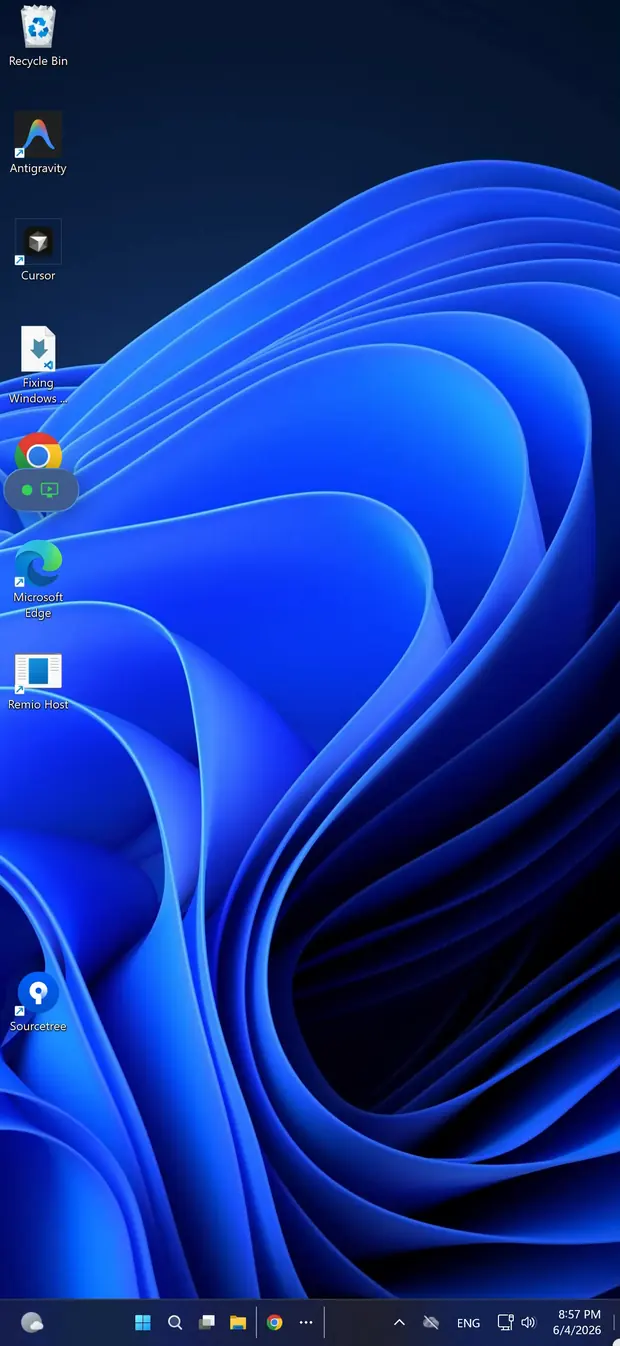
Remio streams a full Mac desktop to a native app on every device — SwiftUI on Apple, Jetpack Compose on Android, C++/WinRT on Windows. No VNC framebuffer, no Chromium runtime in the rendering path: frames go from the hardware decoder to the screen the way the OS intends, which is where the ~8 ms LAN processing latency comes from.

Pair with a six-digit code. No Apple ID, no third-party VNC viewers.

Remio streaming a Mac desktop on iPhone — no Apple ID, no VNC viewer
Technical specs · side by side

The pipeline, spec for spec

Ten specs that decide how a remote-desktop session actually feels. Honest answers — where Apple Screen Sharing leads on discovery, we say so elsewhere; here the codec pipeline is the story.

Spec
Apple Screen Sharing
Remio
Codec
VNC framebuffer (ZRLE / Tight)
H.265 / H.264
Max FPS
~30 (LAN, clean)
60
Max resolution
4K (stutters in practice)
4K (smooth)
Colour
24-bit RGB, no chroma model
4:4:4 on NVIDIA PC → Mac
Audio
None
48 kHz stereo, low-latency
Input
Keyboard, mouse
Keyboard, mouse, gamepad, Apple Pencil, touch
Host platforms
macOS only
macOS, Windows, and Linux (v1.0, X11)
Client platforms
macOS only (others via third-party VNC)
macOS, iOS, iPadOS, visionOS, Android, Windows
Account required
Apple ID or local user
No (six-digit code)
WAN setup
Manual port-forward (TCP 5900)
Automatic STUN + TURN

Last reviewed May 2026 · derived from Apple Screen Sharing documentation and remio.net/security-whitepaper

Common questions

Common questions about Apple Screen Sharing

The six questions Mac users ask before they replace the built-in tool. Straight answers below.

Is Remio faster than Apple Screen Sharing?
Yes, by a wide margin. Remio measures about 8 ms of processing on a LAN (the rest is your display's own 60 Hz refresh cadence) — your input lands before the next frame draws — while Apple Screen Sharing typically sits between 50 and 150 ms because it is built on VNC and uses the RFB framebuffer compression protocol rather than a hardware video codec. The gap is small enough to ignore for occasional admin work and large enough to notice the moment you try to scroll, drag, or type quickly.
Why would I use Remio if Apple Screen Sharing is free and built into macOS?
Apple Screen Sharing is Mac-only on both ends. If you ever want to reach your Mac from an iPhone, iPad, Android device, Windows PC, or Vision Pro, Screen Sharing cannot do it natively — you would need a third-party VNC viewer with all of the latency and colour penalties that implies. Remio is also free, runs as a native app on every platform, and gives you modern H.265 streaming instead of VNC.
Does Apple Screen Sharing work from an iPhone or iPad?
Not directly. There is no Apple Screen Sharing client app on iOS or iPadOS. To reach a Mac over VNC from an iPhone or iPad you have to install a third-party viewer, and the experience is typically slow, lacks Apple Pencil support, and offers no audio. Remio ships a native iOS and iPadOS client with full Apple Pencil support (point, tap, and scroll), hardware-keyboard support, and audio passthrough.
Can I reach my Mac over the internet with Apple Screen Sharing?
Only with manual setup. Apple sunset the iCloud Back to My Mac feature in macOS Mojave in 2018, so wide-area access now requires you to open port 5900 on your router, set up dynamic DNS, or run a third-party tunnel. Remio handles WAN automatically with a STUN and TURN relay system that traverses NAT without router configuration.
How do Apple Screen Sharing and Remio compare on colour and image quality?
Apple Screen Sharing uses VNC framebuffer compression (ZRLE or Tight), which stores colour in 24-bit RGB but ships in chunks that stutter on motion and tear on resize. Remio sends a true H.265 video stream — true 4:4:4 chroma is now live from NVIDIA PCs to Mac (more pairs on the way) — so text, UI, and design surfaces already render with far less fringing than a VNC framebuffer. The difference is visible the first time you scroll a long document.
Is Remio more secure than Apple Screen Sharing?
Baseline VNC is unencrypted, and Apple Screen Sharing only encrypts when you opt into the SSH tunnel mode introduced in macOS 10.5. Remio is end-to-end encrypted by default — your screen never touches our servers, and even a relay only sees ciphertext — and pairs devices using a six-digit code rather than your Apple ID — so there is no shared credential to expose if the connecting device is lost or borrowed.
Other comparisons

Compare Remio to the rest of the field

Same numbers, same structure, thirteen other tools. Pick the one closest to what you already use.

Remio app icon

Try Remio for an afternoon.

Download once, pair with a six-digit code, see the latency and colour on your own LAN. No Apple ID prompt, no router config, no third-party VNC viewers to install on the iPad. Stream from the iPhone in the kitchen, the Windows laptop on the table, the Vision Pro on the couch — same Mac, same pairing, same modern video pipeline. If Apple Screen Sharing still serves you better, you are out exactly one minute.